
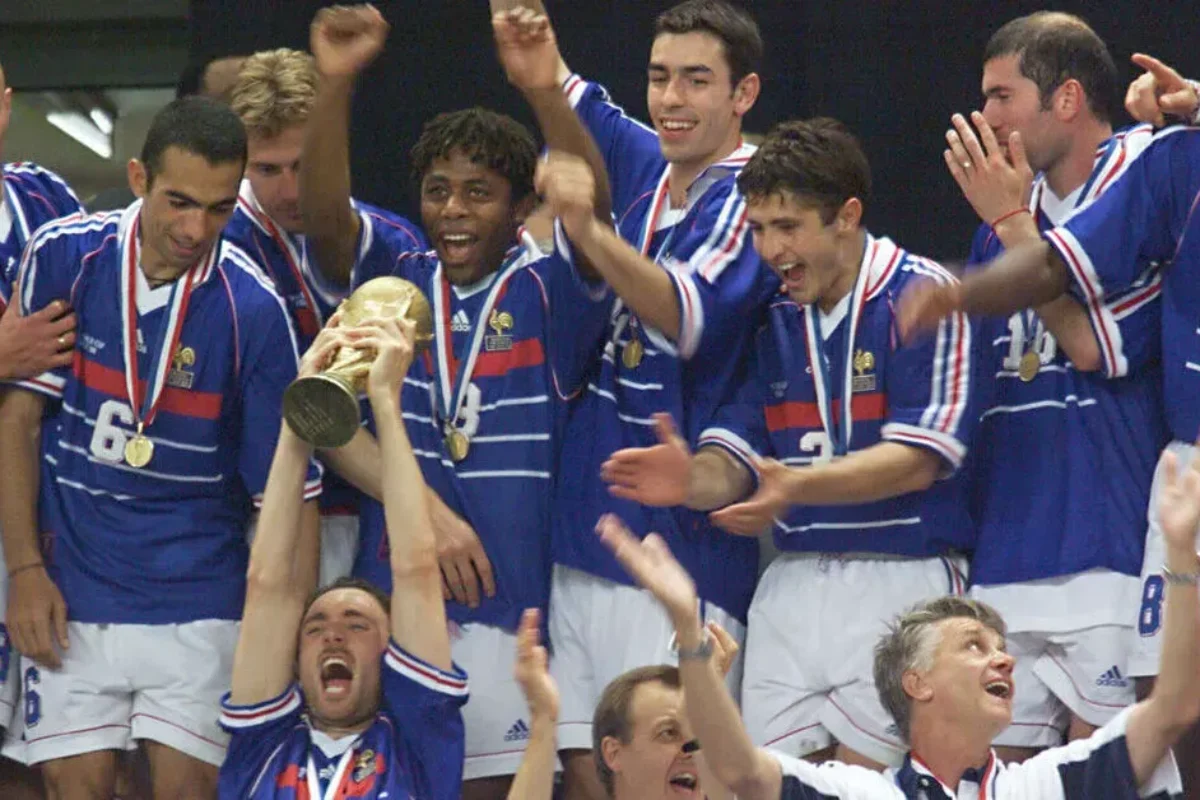
The 1998 World Cup in France allowed more nations to participate in the tournament. Instead of 24 teams, 32 sides would qualify for the World Cup finals.
Therefore, South Africa, Japan, and Jamaica managed to qualify for the first time in history.
The rules divided contestants into eight groups, with four teams each. The top two teams would qualify for the knockout stage of the competition.
The tournament also had a historical moment. Iran and the United States, which had been severe political enemies since 1979, ended up in the same group.
Neither of the teams managed to qualify for the 1998 World Cup tournament’s knockout stage, but the Iranians were the ones who celebrated after beating the United States.
Indeed, the Americans and Iranians gave a great example of sportsmanship: they posed for pictures with their arms around each other and were very polite to one another. In the end, 2-1 victory for Iran.
1998 World Cup Shocks
Despite changes to the 1998 World Cup competition, they were still surprises.
For example, Spain went home early after losing to Nigeria and drawing with Paraguay. But Davor Suker’s Croatia was that tournament’s biggest surprise.

Printable 2022 World Cup Wall Chart
- For all SOCCER FANS out there, this is for you!
- Track All The Scores And Follow The Full Schedule!
- |nstant Download – Print Up To 1500 x 1000mm
- Deluxe printable poster designed especially for the FIFA World Cup With Fixtures, Dates, Stadiums, And Start Times
No longer part of Yugoslavia, the Croats played for the first time as an independent nation. And the national team managed by Miroslav Blazevic showed to be quite strong.
In their 1998 World Cup group stage, they beat Jamaica and Japan and would qualify second in their group, behind no one less than Argentina.
Davor Suker And Croatia
In the round of 16, the Croats beat Romania 1-0, with Davor Suker getting on the scoresheet.
But their most impressive result would come in the quarter-final against Germany. They were not intimidated by the three-time World Cup winners and dispatched them home with a convincing 3-0 win.
However, in the 1998 World Cup semi-final, they had to face the hosts, France.
Suker managed to open the score, scoring his sixth goal in the competition, which would ensure he finished as the tournament’s top scorer, but then, France’s Lilian Thuran decided to take it up a notch.
He had never scored for France before. However, he scored twice in the semi-final, putting France in the 1998 World Cup final.
France’s 1998 World Cup Journey
After seeing Michel Platini’s generation be eliminated twice in the semi-final, France did not inspire much trust in their fans.
Before the tournament, Zinedine Zidane had gone as far as saying, “I’m going to win this 1998 World Cup,” but had not played well until the final.
He almost put everything at risk in the group stage when he stamped on an opponent, was sent off, and suspended for two matches.
Nevertheless, the French won their first three matches and qualified first in the group.
The Knock Out Stage
However, in the round of 16 match, France struggled.
Without the young Zidane, France had to work hard to break through Paraguay’s excellent defensive system, which was made up of keeper Jose Chilavert – somewhat of a controversial figure – and Carlos Gamarra, an exceptional defender.
However, Laurent Blanc scored the golden goal during extra time to put France through to the 1998 World Cup quarter-final.
The young Zidane was back for the quarter-final against Italy and helped France get through on penalties.
The semi-final against Croatia was also exciting: Thuram scored his first two goals for France, putting them in the final.
Young Zidane And His Brillance
Against Brazil, the 1994 winners, the young Zidane finally showed his brilliant football. In the first half, France’s number 10 scored two, making it 2-0 for the French national team.
Lost on the pitch, the Brazilians could not pull it back, and Emmanuel Petit sealed the French win before referee Said Belgola from Morocco put an end to the match.
He was the first African referee to officiate a FIFA World Cup final. France won their first title in history, and celebrations took over the country, with around one million fans taking to the streets of the Champs Élysées.
Where Is Ronaldo?
As 1994 World Cup winners, Brazil did not have to qualify for the tournament in France. Instead, they had to prepare through friendly matches.
Still, they were in high spirits. After all, they had Ronaldo, who was selected FIFA world player of the year in the previous two years.
Printable 2022 World Cup Wall Chart
- For all SOCCER FANS out there, this is for you!
- Track All The Scores And Follow The Full Schedule!
- |nstant Download – Print Up To 1500 x 1000mm
- Deluxe printable poster designed especially for the FIFA World Cup With Fixtures, Dates, Stadiums, And Start Times
However, problems started before the World Cup. Romário, the hero of the 1994 winning campaign, was cut because of injury by manager Zagallo a little before the 1998 World Cup.
He stated it was a light injury at the time, but the technical staff would not change their minds. However, the striker never came to terms with this decision.
Without Romario, Brazil had Ronaldo, Bebeto, and Rivaldo. But on the group stage, the best Brazilian player was Cesar Sampaio.
Brazil’s 1998 World Cup Journey
Brazil’s national team had victories over Morocco and Scotland in the first two matches.
However, a defeat to Norway exposed some weaknesses in the team, although it did not compromise their place in the knockout stage.
A convincing win over Chile in the round of 16 cheered the fans up. Then, in the quarter-final, Rivaldo shone and scored two goals in Brazil’s 3-2 victory over Denmark.
In the 1998 World Cup semi-final against the Netherlands, keeper Claudio Taffarel saved the day.
The match ended in a draw and had to be decided on penalties. Brazil’s goalkeeper saved two penalties, which put Brazil in yet another final.
What Happened In The 1998 World Cup Final
However, the 1998 World Cup final was a cold shower for Brazilian fans, who watched a low-spirited team be dominated by France and lose 3-0.
A strange episode before the match, not cleared up fully until today, would become a World Cup mystery.
Forward Ronaldo suffered a seizure hours before the final. As a result, Brazil’s starting line-up was announced before the match with Edmundo as Ronaldo’s replacement.
However, after being assessed by doctors, Ronaldo got the all-clear to play.
Nevertheless, his teammates, worried about his health, lost their focus. Indeed, Ronaldo did not resemble himself on the pitch.
Rhett is an Australian-born, globe trotter who is a UEFA ‘A’ Licence Soccer Coach. With his family, he has traveled and coached soccer in more than 30 countries, while attending World Cups, European Championships, and some of the biggest local derbies in the world!
